January Will Decide: Bear Market Confirmation or Bull Market Continuation

Happy New Year to everyone reading. I hope 2026 brings you clarity, strong decision-making, and better risk-adjusted returns.
January matters more than most months. Not because it can “predict” the year, but because it will likely determine whether the market is confirming a broader downtrend (bear market structure) or rebuilding momentum to continue the bull cycle.
Why sentiment is fragile right now
November and December were difficult for crypto. The market was still digesting the October 10 liquidation event, while we also witnessed a clear transfer of wealth from OG whales to “new blood” in the market, institutions and retail.
As a result, the Bitcoin community is split into two camps:
The cycle purists: They believe the 4-year cycle remains intact. Their base case is that Bitcoin already topped, and the market will grind lower into late 2026, potentially reaching a 50 to 70 percent drawdown from the all-time high (Bitcoin is currently around 29 percent off the ATH).
The structural-break camp: They believe 2026 will deliver a new all-time high and that the traditional cycle framework will be disrupted by major tailwinds such as institutional adoption, regulatory clarity, and a rate-cut environment.

To frame what comes next, we need to focus on what January can realistically change: liquidity, regulation, and risk appetite.
The three January catalysts that can move markets
Major Banks Deepening Crypto Integration: Institutions like JPMorgan, Morgan Stanley, and others are advancing their crypto offerings, with recent filings and announcements indicating spot Bitcoin ETFs and custody services could roll out or expand as early as January 2026. For instance, Morgan Stanley has filed for Bitcoin, Ether, and Solana ETFs, marking a significant push into direct crypto exposure for institutional clients. JPMorgan is exploring spot and derivatives trading options, building on prior moves like using Bitcoin and Ethereum as collateral for loans. This could flood the market with liquidity, enabling large-scale portfolio allocations (think 1-5% from hedge funds, pensions, and endowments), further legitimising Bitcoin as an asset class and potentially dampening volatility over time.
Potential U.S. Government Shutdown: The current funding extension via a continuing resolution expires on January 30, 2026. Without a new budget deal, non-essential federal operations could grind to a halt, injecting uncertainty into broader markets. Analysts peg the odds at around 27-38%, fueled by congressional deadlock over priorities like healthcare and debt limits. While past shutdowns have been brief with minimal lasting impact, this could heighten short-term risk aversion in crypto—especially amid fiscal debates under the new administration.
The Clarity Act Vote: The Digital Asset Market Structure Bill (also known as the Clarity Act or H.R. 3633) is gearing up for key committee votes and potentially a floor vote in January 2026, ahead of midterm election fervour. This framework would clarify crypto classifications (e.g., commodities vs. securities), streamline exchange compliance, and regulate stablecoins, paving the way for smoother U.S. operations. Sources suggest a 50-60% passage chance early in the year, with the crypto industry ramping up lobbying efforts. Success could unleash massive institutional inflows and innovation; delays, however, might extend uncertainty into the election season, making approval tougher post-mid-2026.
From a data standpoint, Bitcoin has the fundamentals to push higher and breach $100K, but we need renewed interest flowing back into the market. This could come from institutions, a rotation from strong-performing commodities in 2025, or positive outcomes from the Clarity Act. Trading volumes for Bitcoin and the broader crypto market plummeted in November and December 2025, signalling reduced liquidity and waning enthusiasm. We've seen a brief spike in early January 2026 volumes (e.g., around $39-47 billion in 24-hour trading), but it's not yet enough to confirm a trend reversal.
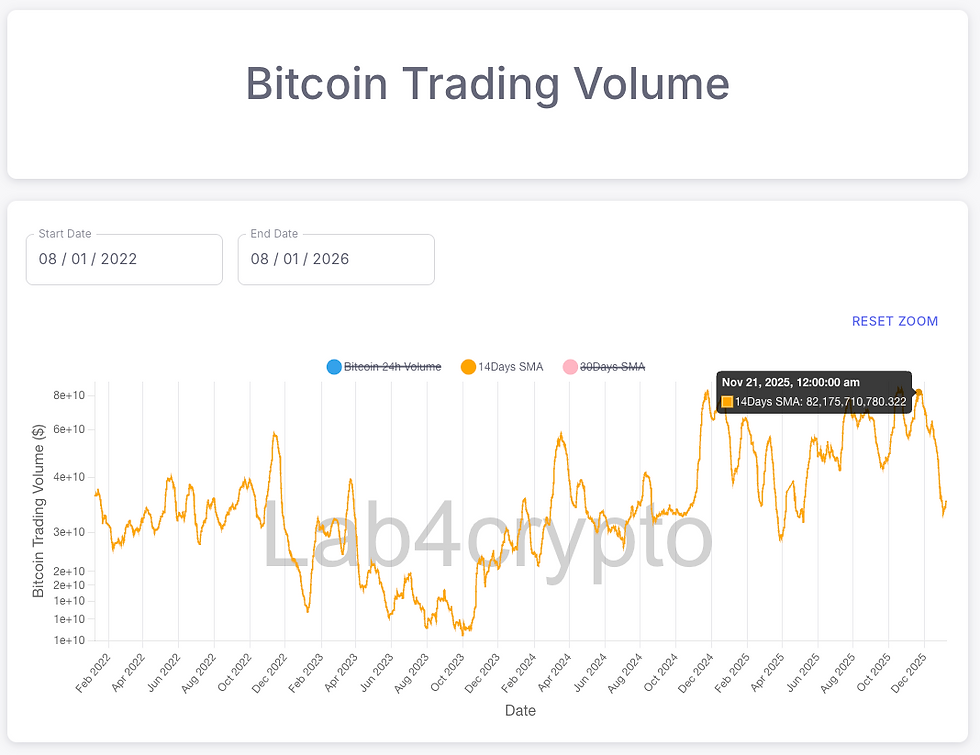
Beyond low volumes, Bitcoin's & Ethereum social sentiment, measured by Google Trends, also reflects muted interest, hitting one-year lows as 2025 wrapped up. Hopefully, January's headlines will ignite a spark and clarify the year's direction.

Technically, Bitcoin has held the 100-week SMA admirably since November 2025, positioning it as a critical support level (currently around $86K). Losing this could drag us toward $75K, particularly if January events turn into headwinds. On the upside, major resistance looms at $94.5K; breaking it could propel us to test $100K, a psychologically vital milestone and roughly aligned with the 200-day SMA. With favourable January developments, this seems achievable, setting the stage to shatter the 4-year cycle narrative.

Our flagship risk indicator currently reads low at 19.4%, suggesting Bitcoin is primed for an explosive upside move. Much of the profit-taking has already played out, with on-chain data like Spent Output Profit Ratio (SOPR) showing sales at a loss from November to December 2025. Whale selling appears to have tapered off, with recent metrics indicating accumulation by large holders, though exchange activity remains elevated in a low-volume environment. All it needs is a catalyst, but outcomes like the Clarity Act could complicate upside if they disappoint, as institutions are watching closely.

Conclusion: January is the pivot month
January 2026 stands as a make-or-break moment for Bitcoin and the crypto market:
If liquidity remains thin and macro or political headlines become risk-off, the market can confirm a broader downtrend and move toward lower support zones.
If attention and capital return, and if January’s catalysts resolve positively (especially on regulation and institutional access), Bitcoin has the structure to rebuild momentum, reclaim $100K, and challenge the idea that the 4-year cycle must play out exactly as it did before.
For now, the market is waiting. January will tell us what it is waiting for.